
Last Updated: November 27, 2026
Quick Summary
After a coastal storm floods your pool with seawater, stay out of the water and keep the power off until the area is assessed. A flooded pool holds salt, sediment, and debris that can damage surfaces, plumbing, and electrical systems, so test the water and inspect equipment before treating or restarting anything.
- Turn off power to pool equipment at the breaker before cleanup begins.
- Test salinity first, since seawater is roughly 35,000 ppm of salt.
- Do not drain automatically; high groundwater can float an empty pool out of the ground.
- Clear the pump basket and lines before starting the pump.
- Shock only after testing and confirming pH is in range.
Table of Contents
- What should you do after a coastal storm floods your pool with seawater?
- Pool water testing after a storm: where to start
- Should you drain a flooded pool? A decision framework
- Pool equipment inspection after flooding: pumps, filters, and electrical
- How to shock a pool after heavy rain and seawater intrusion
- Request a professional pool recovery assessment
- Frequently Asked Questions
What should you do after a coastal storm floods your pool with seawater?
After a coastal storm floods your pool with seawater, stay out of the water and away from the equipment pad until you have assessed safety.
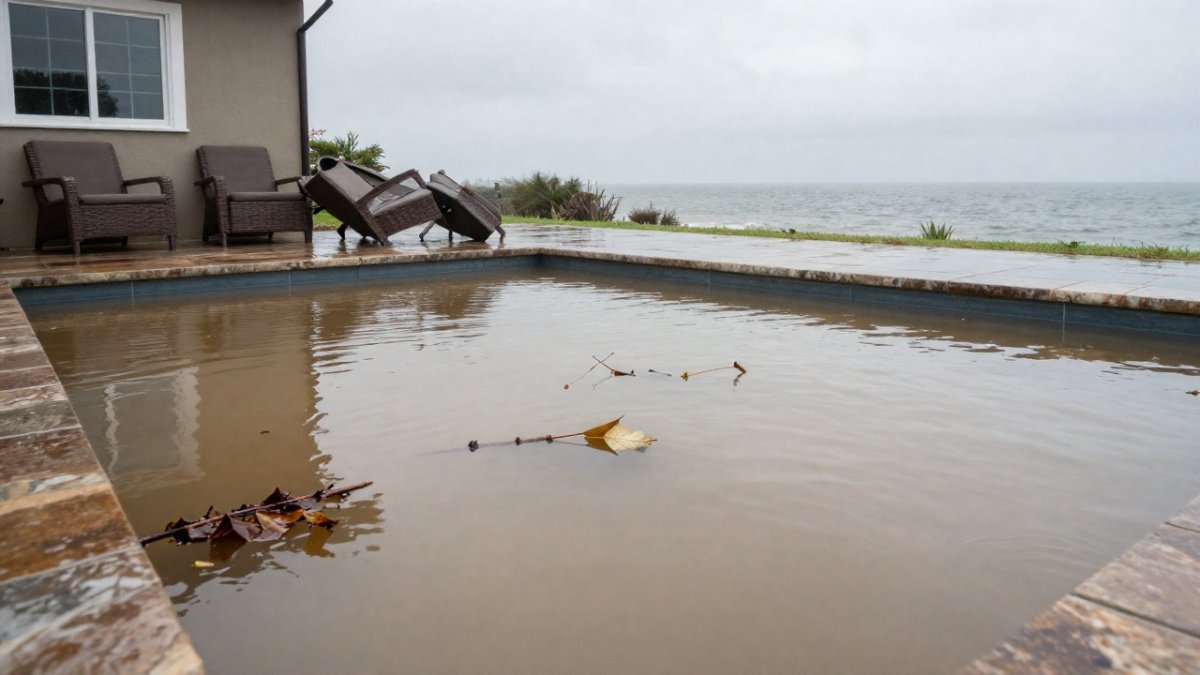
Do not pump, drain, or restart anything on day one. Assess first.
Saltwater intrusion is not the same as a heavy rain event. A flooded pool holds a mix of ocean water, storm runoff, mud, and whatever the surge carried in.
Here is the short version of what to do:
- Keep people and pets out of the water
- Photograph the damage for insurance
- Test the water before you treat it
- Inspect equipment before you power it on
- Decide between draining and water exchange with care
Below, we break down each step. But first, here is what most guides get wrong: they tell you to drain immediately.
Step 1: Make the area safe
Safety comes before cleanup. Floodwater can hide sharp debris, and standing water near electrical equipment is a shock hazard.
- Turn off power to the pool equipment at the breaker
- Keep everyone out of the water and off a flooded deck
- Watch for downed lines and damaged outlets
- Wear gloves and boots when you start clearing debris
Do not touch a pump, heater, or light fixture that has been underwater. Call a licensed electrician before anything runs again.
Pool water testing after a storm: where to start
Pool water testing after a storm starts with a full test kit, not a guess.
Test in this sequence so each result is trustworthy:
- Salinity first. Seawater is roughly 35,000 parts per million (ppm) of salt, so even a modest surge can push a pool far above the 2,700-3,400 ppm range most salt chlorine generators expect. Test with a salinity meter or titration kit, not test strips.
- pH next. Floodwater and seawater both push pH high, and a high pH reading makes chlorine look weaker than it is. Record pH before you judge free chlorine.
- Free chlorine and combined chlorine. Free chlorine tells you what sanitizing power remains; combined chlorine (chloramines) tells you how much contamination the water carries. High combined chlorine after a surge signals that oxidation, not just more chlorine, is needed.
- Cyanuric acid. Storm runoff dilutes stabilizer, while sediment can cloud the reading. If cyanuric acid is very low, chlorine burns off fast in sunlight and your shock will not hold.
- Total dissolved solids (TDS). Seawater and mud both raise TDS. A reading well above your normal baseline is one of the clearest signs that a water exchange, not just a shock, is warranted.
- Calcium hardness and total alkalinity. These complete the picture and tell you whether the water will scale or corrode metal fittings after the salt load settles.
Write every result down with the date and time.
A common mistake is shocking a pool before testing. You waste chemicals and still cannot tell what changed. Test first, then treat.
Watch out: test strips are fine for routine checks but too imprecise for post-surge salinity and TDS.
Retest after each major step, after debris removal, after any partial drain and refill, and after shocking, so you can see which change moved the numbers.
Should you drain a flooded pool? A decision framework
You should not drain a flooded pool automatically. Draining is sometimes right and sometimes dangerous, so the decision needs an on-site assessment.
Use this framework to decide:
|
Situation |
Safer choice |
Why |
|---|---|---|
|
High groundwater, saturated soil |
Partial drain or water exchange |
Full drain risks the pool popping up |
|
Heavy mud and sediment on the floor |
Professional assessment first |
Sediment weight and surface damage need a look |
|
Salinity only slightly high |
Water exchange and rebalance |
Cheaper and safer than a full drain |
|
Cracked shell or lifted deck |
Stop and call a pro |
Structural damage changes everything |
|
Clean water, minor debris |
Skim, filter, and shock |
No drain needed |
The honest answer is that draining versus water exchange is a judgment call.
AQUA Magazine guidance on storm-flooded pools notes that storm-surge pools may need draining, but warns that high groundwater after flooding creates a serious risk of the pool popping up.
If you are weighing a drain against professional care, our guide to professional pool maintenance explains what routine service covers and when to hand off the work.
Pool equipment inspection after flooding: pumps, filters, and electrical
Pool equipment inspection after flooding means checking every component before you power it on.
Work through the system in order:
- Electrical first. Have a licensed electrician confirm the panel, wiring, breakers, and bonding are dry and safe. Do not reset a breaker to “see if it works” on equipment that was submerged.
- Pump. Open the strainer basket, clear debris, and check the motor housing for water. Seawater left inside a motor promotes rust on bearings and windings; a motor that sat wet in salt water is a strong candidate for replacement rather than restart.
- Filter. Inspect for sediment, check the pressure gauge, and plan a backwash or clean. Sand and cartridge filters can hold fine silt and salt residue that keeps clouding the water long after the pool looks clear.
- Heater. Look for corrosion on the heat exchanger and cabinet. A heater that took on seawater should be inspected before firing.
- Salt chlorine generator cell. Remove the cell, inspect the plates for scale and corrosion, and clean it per the manufacturer’s instructions. Check the cell and the flow switch before trusting the system.
- Valves and plumbing. Clear blockages and check for cracks. Salt water accelerates corrosion on metal fittings, ladders, rails, and light rings, so inspect those too.
Do not start the pump until the basket and lines are clear. Running a pump dry or full of grit can burn out the motor.
Starting equipment before the debris is cleared can turn a recoverable pump into a replacement. If your pump is tripping breakers or shutting off, our guide to pool pump repair covers the likely causes and fixes.
How to shock a pool after heavy rain and seawater intrusion
How to shock a pool after heavy rain and seawater intrusion depends on your test results, not a fixed dose.
The sequence that works:
- Clear debris and sediment first
- Confirm pH is in range before shocking
- Add shock per the product label
- Run the filter and circulate
- Retest after the shock has worked
- Rebalance pH, chlorine, and stabilizer
Then run the filter long enough to clear the water. Backwash or clean when the pressure gauge climbs.
If salinity is high, a partial drain and refill lowers it before you shock. Shocking salty, muddy water without exchanging some of it wastes chemicals.
For salt systems, clean the salt cell and check the metal components for corrosion after the water settles.
PHTA resources on pool water chemistry can help you confirm safe chemical ranges for your system type.
Request a professional pool recovery assessment
A professional pool recovery assessment is the safest way to handle a seawater flood when you are unsure about draining, equipment damage, or water chemistry.
At Peerless Pools, we have served shore homes and rental properties since 2016, and we are a trained Pentair specialist.
We offer weekly pool service and seasonal care for shore homes and rental properties. If you want to see what ongoing care includes, review our weekly pool service in Cape May County. You can also explore our full range of pool services for openings, closings, repairs, and equipment upgrades.
Do not wait for the water to clear on its own. Reach out through our contact page to schedule a recovery assessment.
A flooded pool after a coastal storm is stressful, but it is manageable with the right order of steps.
Frequently Asked Questions
Can you swim in a pool after seawater floods it?
No. Seawater flooding introduces bacteria, debris, and unbalanced chemistry that make swimming unsafe until the water is tested and treated. Wait until pH, chlorine, and salinity are back in range and the water is clear. If the pool was overrun by floodwater carrying sediment or runoff, a professional assessment is the safest way to confirm it is ready for swimmers.
Do you need to shock a pool after heavy rain?
Heavy rain dilutes chlorine and can introduce contaminants, so shocking is often necessary. Test the water first to see how far chlorine has dropped, then use a shock treatment suited to your pool type. For saltwater pools, check salinity before shocking. Run the filter continuously and retest after 24 hours to confirm chlorine holds.
Can seawater damage pool equipment?
Yes. Saltwater and sediment can corrode metal components, clog filters, and stress pumps if they run before debris is cleared. Inspect the pump basket, filter, heater, and salt chlorine generator before startup. Rinse salt residue from exposed metal and have a technician check electrical connections. Prompt inspection after flooding prevents longer-term damage.
How do you test pool water after seawater contamination?
Test salinity first with a salt test kit, then check pH, free chlorine, and total alkalinity. Seawater raises salinity sharply, so you may need partial water replacement to bring it back to the target for your salt chlorine generator. Record results before and after each adjustment so you can track recovery and confirm the water is safe.
