
Last Updated: November 7, 2026
Quick Summary
Preventing pool downtime during summer rentals means testing chlorine, pH, and alkalinity once a week, and keeping a written log of every reading.
- Test water after every checkout and shock only when chlorine is low or water is cloudy.
- A weekly service visit should cover water testing, chemical adjustment, surface cleaning, filter care, and equipment inspection.
- Close the pool when free chlorine is at or near zero and the water is cloudy or green.
- Send guests a closure message as soon as a closure threshold is crossed, not after the repair is scheduled.
Table of Contents
- Why Pool Downtime Costs More Than a Repair Bill
- Build a Vacation Rental Pool Cleaning Schedule That Survives Turnover
- Weekly Pool Maintenance for Vacation Rentals: What a Service Visit Should Cover
- Water Testing and Chemical Balance Between Guest Stays
- Pool Pump Troubleshooting for Rental Properties Before It Becomes an Emergency
- Pool Safety Guidelines for Vacation Rentals That Protect Hosts and Guests
- A Downtime Response Plan and Backup Coverage for Peak Season
- Request a Pool Care Quote Before Your First Summer Booking
- Frequently Asked Questions
Why Pool Downtime Costs More Than a Repair Bill
Preventing pool downtime during summer rentals is the difference between a booked calendar and a stream of refund requests.
Shore rental pools can be lost to the same pattern every season. A host treats the pool as a repair problem.
The Consumer Product Safety Commission has tracked at least 64 fatal child drownings in pools or spas at vacation rental homes from 2019 through 2025, according to CPSC pool safety guidance for vacation rentals.
Below, we break down the seven risks that cause most summer outages, and the schedule that keeps them from happening.
|
Risk |
Early Warning Sign |
Typical Fix |
|---|---|---|
|
Poor water chemistry |
Cloudy water, chlorine smell |
Balance pH and alkalinity |
|
Clogged filter |
Weak return flow |
Clean or backwash filter |
|
Pump failure |
Grinding noise, no pressure |
Inspect and repair pump |
|
Algae bloom |
Green tint on walls |
Shock and brush |
|
Low water level |
Skimmer pulling air |
Top off and check for leaks |
|
Missed turnover |
Debris after checkout |
Reset cleaning schedule |
Build a Vacation Rental Pool Cleaning Schedule That Survives Turnover
A vacation rental pool cleaning schedule is a written plan that assigns every cleaning task to a day, a person, and a check. It survives turnover because it does not depend on memory.
Most hosts start with good intentions and no calendar. Then a Saturday checkout runs late, the cleaner skips the skimmer, and the next guest arrives to leaves and sunscreen film.
Weekly, and Turnover Tasks
Split the work into two rhythms:
- Daily (guest or co-host):
- Weekly (service visit): full chemical test, brush walls, vacuum, clean the filter, inspect equipment skim the surface, check the water level, empty skimmer baskets, note anything odd.
- Turnover (between stays): skim, shock if needed, test water, restock, and log the result.
For hosts who want the weekly rhythm handled by a professional, our weekly pool service in Avalon, NJ covers full-season cleaning, water balancing, and equipment checks.
Weekly Pool Maintenance for Vacation Rentals: What a Service Visit Should Cover
Weekly pool maintenance for vacation rentals should cover five things every visit: water testing, chemical adjustment, surface cleaning, filter care, and an equipment inspection.
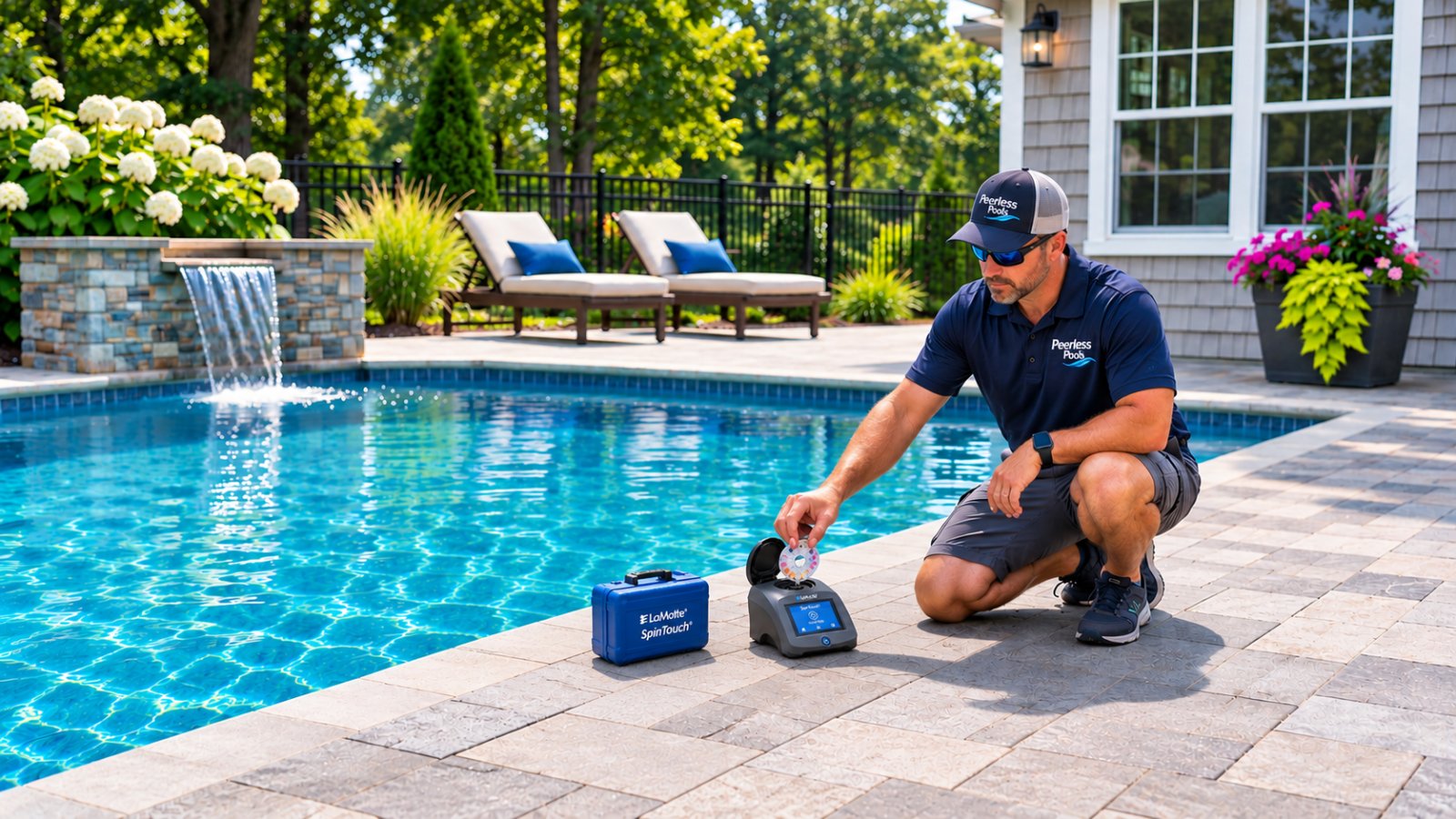
Pool technician testing water quality to prevent pool downtime at a vacation rental property
A thorough weekly visit typically includes these checks:
A visit that skips the equipment check is how small leaks become big ones. For hosts comparing scope, our weekly pool service in Cape May County, NJ lists exactly what is included.
Water Testing and Chemical Balance Between Guest Stays
Water testing between guest stays means checking chlorine, pH, and alkalinity after every checkout, or once a week.
Chlorine kills bacteria. pH measures how acidic the water is. Alkalinity buffers pH so it does not swing.
A common mistake is dumping in shock without testing first. That can push pH out of range and make the water harsh.
- Test after every checkout
- Shock only when chlorine is low or the water is cloudy
- Add algaecide as a preventive, not a rescue
For a deeper look at what weekly service includes for rentals, see our guide to weekly pool service in Cape May County NJ.
Pool Pump Troubleshooting for Rental Properties Before It Becomes an Emergency
Pool pump troubleshooting for rental properties starts with three checks: is the pump running, is water moving, and is the filter clean.
Warning Signs Guests Report First
Guests rarely say “the pump is failing.” They say the water looks dull, the jets feel weak, or there is a grinding noise. Treat those as early warnings.
- Loud grinding or whining
- Weak or no return flow
- Filter pressure climbing fast
If your pump is showing these signs, our Pentair pool equipment and installation service covers pumps, heaters, and salt systems before a small fault becomes a holiday weekend emergency.
Pool Safety Guidelines for Vacation Rentals That Protect Hosts and Guests
Pool safety guidelines for vacation rentals are the rules, equipment, and checks that keep guests safe and hosts protected. They are part of running a rental, and the part most likely to be tested by a guest who has never seen the property before.
At minimum, a rental pool should have:
- A self-latching, self-closing gate on any barrier, with the latch out of a child’s reach
- A pool alarm or door alarm on the house side (optional) (Simple Safety Steps Series)
- Clearly posted pool rules at the gate and inside the house
Check your setup before every season, not after a near miss.
Rental-Specific Safety Checks Before Every Turnover
A family pool gets checked by the same people every day. A rental pool gets checked by a new guest every few days, so the safety check has to happen between stays, not just in spring.
- Walk the barrier and gate and confirm the latch closes and holds.
- Confirm the pool alarm is armed and the battery is good (optional).
- Check that drain covers are flat, secure, and uncracked.
Log the result of each check in the same shared log used for water tests. A dated safety check is the clearest evidence that the property was maintained to a consistent standard.
Guest-Facing Rules That Reduce Risk
Rules work when they are short, visible, and repeated in the booking message.
- No swimming alone.
- No diving into shallow water.
- Children must be supervised by an adult at all times.
Put the same rules in the check-in message and the house manual. Guests read the message more often than the sign.
When to Close the Pool for Safety
Safety closures are separate from maintenance closures. Close the pool and tell guests immediately when:
- A gate or barrier will not latch.
- A drain cover is loose, cracked, or missing.
- The pool light or electrical panel shows a fault.
Reopen only after the fault is repaired, the water is clear, chemistry is in range, and the barrier and drain covers have been rechecked. Record the closure and the reopening in the log.
Watch out: a guest who moves a gate prop or disables an alarm can undo a season of preparation. Check the barrier and alarm at every turnover, not just at the start of the season.
Documentation and Insurance Readiness
Keep the safety log, equipment model and serial numbers, service records, and posted rules together. If an incident occurs, the first questions will be what was checked, when, and by whom. A dated log answers those questions; memory does not. Review liability coverage with the insurer before the season and confirm the pool, barrier, and alarms are described accurately.
A Downtime Response Plan and Backup Coverage for Peak Season
A downtime response plan is a written set of steps for what happens when the pool fails during peak season. It names who to call, in what order, what guests are told, and what evidence you keep.
The plan should be one page, stored where a co-host or property manager can reach it at 9 p.m. on a holiday weekend.
The Escalation Ladder
Write the order of contact before the season starts, with names and phone numbers, not just company names.
- On-site responder, the cleaner, co-host, or property manager who can look at the pool and report what is happening. They document, not diagnose.
- Primary pool vendor, the company holding the service contract. Give them the responder’s notes, not a vague “pool is broken” message.
- Equipment manufacturer or distributor, for warranty parts, control boards, or heaters. Keep model and serial numbers for the pump, heater, filter, and salt system with the plan.
- Owner or host, the person who authorizes spending above a set limit and decides whether the pool closes.
Closure and Reopening Thresholds
A closure threshold is the line where the pool stops being usable. Write it down so the decision is not made in a panic.
Close the pool when any of these is true:
- Free chlorine is at or near zero and the water is cloudy or green.
- The pump is not moving water and the filter is not circulating.
- The water level is below the skimmer mouth and the pump is pulling air.
Reopen only after a full chemical test is in range, the pump has run and held pressure, the filter is clean, and a visual check of the barrier, gate, and drain covers is complete.
Guest Communication and Service Recovery
Guests tolerate a closed pool far better than a silent host. Send the message as soon as the closure threshold is crossed, not after the repair is scheduled.
- State what is closed, why in plain language, and the expected timeline if known.
- Offer a specific alternative, a nearby public pool, a beach pass, or a late checkout, rather than a vague apology.
- Put the same message in the booking platform inbox so it is documented.
Documentation That Protects the Host
Keep one shared log per property or online. Record the date and time of each water test, equipment reading, service visit, closure, reopening, and guest message. It shows a pattern before a failure and demonstrates consistent care if a guest disputes the pool’s condition.
Request a Pool Care Quote Before Your First Summer Booking
The best time to line up pool care is before the first booking, not after the first complaint.
At Peerless Pools, we are locally owned and have served shore homes and rentals since 2016.
Get ahead of the season. Contact our team to request a quote.
Summer rentals leave no room for a pool that quits mid-season.
Frequently Asked Questions
How often should a vacation rental pool be serviced during summer?
Most short-term rental pools need a professional visit at least once a week during peak summer bookings. High occupancy, heavy bather loads, and coastal debris speed up chemical demand, so a pool that sits untouched for ten days can turn cloudy before the next guest arrives. A weekly pool maintenance for vacation rentals plan that also covers turnover days keeps water clear and equipment running. Ask your provider how they handle same-day visits between checkouts and arrivals.
What should a host do if the pool pump stops working before a guest checks in?
Switch the pump off to prevent overheating, check the breaker and skimmer basket, and call your service provider immediately. Pool pump troubleshooting for rental properties starts with the obvious: a tripped breaker, a clogged basket, or a low water level can all stop circulation. If the repair cannot happen before arrival, tell the guest in advance and offer a clear timeline or alternative. Never leave a pool open to guests when circulation or safety equipment is compromised.
How many days can a pool go without a running pump?
A pool without circulation can start turning cloudy or green within 24 to 48 hours in hot weather, and faster with a heavy bather load. Standing water also gives mosquitoes and algae a head start. Treat any pump outage longer than a day as an emergency during summer bookings. Keep a spare basket, breaker check, and your provider’s emergency number on hand, and document the outage so you can show what was done and when.
How should a host communicate a pool closure to guests?
Tell guests as soon as you know, not when they arrive. State the reason in plain language, give a realistic reopening window, and offer a concrete alternative such as a nearby beach day or a partial refund. Follow up when the pool reopens. Clear communication turns a pool downtime complaint into a service recovery story, and it protects your reviews. Keep a short closure template ready before the season starts so you are not writing it under pressure.
